Window Treatments Do More Than You Think
Windows get less decorating attention than almost any other feature in a room, which is strange, because window treatments do four jobs at once: they control light, manage privacy, insulate against heat and cold, and finish the room visually. A bare window makes even a well-furnished room feel temporary. The right treatment makes it feel complete — and the wrong one fights everything else you have done in the space.
Choosing well comes down to answering three questions in order: what do you need the treatment to do, what does the room require, and what looks right. Get those in the right order and the options narrow themselves dramatically. This guide walks through curtains, blinds, and shades, then goes room by room so you can decide with confidence instead of guessing at the store.
The Three Decisions: Light, Privacy, Style
Before looking at any product, settle what each window must accomplish. Light control ranges from "block everything" (bedrooms, media rooms) to "filter harsh sun but keep the view" (living areas) to "barely there" (a window with a great view and no neighbors). Privacy depends on sightlines: a ground-floor window ten feet from the sidewalk needs more coverage than a second-story window facing trees. Style is last because function eliminates most candidates — but it is still what you will live with every day, so it matters.
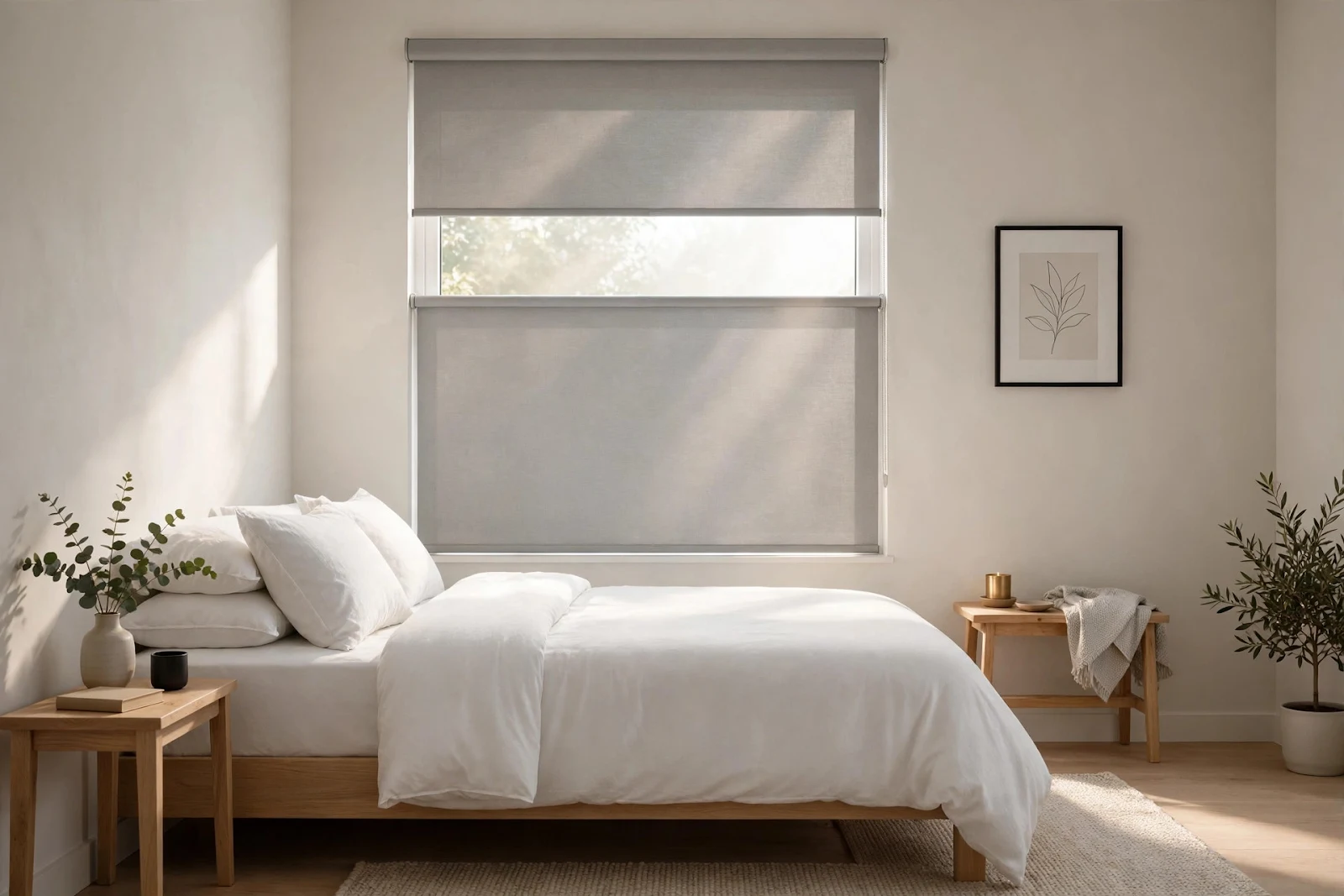
One treatment rarely does everything perfectly. Bedrooms often pair blackout curtains with a light-filtering blind underneath, so you get daytime privacy and nighttime darkness. Living rooms combine decorative side panels with a functional roller shade. Layering is not cheating; it is how professionals handle windows that need to be beautiful, private, and dark at different times of day.
Curtains and Drapes: Softness and Drama
Curtains are fabric panels hung from a rod, and drapes are their heavier, often lined cousins. They are the softest option, and they change a room's acoustics as well as its look — fabric absorbs sound, which is why rooms with curtains feel calmer than rooms with only hard blinds.
When curtains win: living rooms, bedrooms, and any space where you want warmth and visual softness. Floor-length panels that puddle slightly or just kiss the floor look intentional; panels that stop at the windowsill look like a mistake, unless they are a deliberate cafe style in a kitchen.
Fabric and lining matter. Sheers diffuse light beautifully but offer almost no privacy at night when interior lights are on — a classic disappointment. Linen looks relaxed but wrinkles and fades in direct sun. For bedrooms, a blackout lining on the back of a decorative face fabric gives you the look you want with the darkness you need. Thermal linings add a real, measurable layer of insulation against cold windows.
The hanging height rule: mount the rod 4 to 6 inches above the window frame (or closer to the ceiling for low windows) and extend it 3 to 6 inches beyond the frame on each side. Curtains hung high and wide make the window — and the room — look bigger. Panels hung right on the frame, at frame height, make windows look small. This one rule fixes more sad-looking windows than any fabric choice.

Blinds: Precision and a Clean Look
Blinds are hard slats — wood, faux wood, aluminum, or vinyl — that tilt to control light and lift to clear the window. They give the most precise light control of any category: tilt the slats and you can redirect sun away from your eyes while keeping the room bright.
Wood and faux wood suit living rooms and bedrooms. Real wood looks richer but warps in humidity, so keep it out of bathrooms and kitchens. Faux wood handles moisture fine and costs less; the difference is visible up close but negligible from across the room. Aluminum mini-blinds are the budget workhorse — functional, easy to clean, but they read as utilitarian, so they suit rentals and utility spaces more than feature rooms. Vertical blinds belong on sliding doors and wide windows, where horizontal blinds would be awkward to operate.
Blinds' weakness is dust. Slats collect it, and cleaning a full set of blinds is nobody's favorite Saturday. A microfiber duster run across the slats monthly keeps it manageable. In kitchens, where grease joins the dust, wipeable faux wood beats real wood every time.
Shades: The Middle Ground
Shades are single panels or pleated constructions that raise and lower. They read cleaner and more modern than curtains, softer than blinds, and they come in more varieties than most shoppers expect.
Roller shades are the minimalist's choice: a single sheet of fabric on a tube. They disappear when raised, come in light-filtering to blackout opacities, and work in nearly every room. Roman shades fold into soft pleats when raised and lie flat when lowered — tailored and elegant, good for living rooms and dining rooms. Cellular (honeycomb) shades have a pleated structure with air pockets that insulate; they are the best pick for drafty windows and for rooms where energy efficiency matters. Woven wood shades bring natural texture — bamboo, grasses, reeds — and filter light beautifully, though they offer limited privacy on their own and usually pair with a liner.
Shades pair well with side-panel curtains for the layered look, and most now come in cordless versions, which are both safer for households with children or pets and cleaner looking.
Room by Room: What Actually Works
Living room
Prioritize filtered light and a finished look. A light-filtering roller or cellular shade for function plus floor-length side panels for style covers nearly every living room. If the room faces west and gets blasted with afternoon sun, add a solar shade layer that cuts glare while preserving the view.
Bedroom
Darkness wins. Blackout-lined curtains or blackout roller/cellular shades are non-negotiable for most sleepers — even small light leaks around the edges disrupt sleep. Mount blackout treatments outside the frame with generous overlap, because light sneaks through gaps at the edges. If you like waking with natural light, a light-filtering layer underneath the blackout layer gives you the option.
Kitchen
Keep it simple and wipeable. Faux-wood blinds, roller shades, or short cafe curtains on the lower half of the window all work; avoid long fabric near the stove and anything that cannot survive a splash. Top-down/bottom-up cellular shades are a kitchen star: lower them from the top for daylight while keeping the lower half private.
Bathroom
Moisture rules everything. Faux-wood blinds, vinyl roller shades, or frosted window film handle humidity; real wood and unlined fabric do not. Top-down/bottom-up operation shines here too — light from the top, privacy at the bottom.
Home office
Glare is the enemy. Position the desk perpendicular to the window if you can, then add a light-filtering shade that cuts glare without making the room cave-like. If video calls happen here, consider what the camera sees: a simple, uncluttered treatment behind you reads better than busy patterns.
Measuring Right: Inside Mount vs. Outside Mount
Measuring wrong is the most expensive mistake in window treatments, because custom sizes are final sale. Decide the mount first. Inside mount sits within the window frame — clean and modern, but it needs at least 2 inches of frame depth for most blinds and shades, and it leaves a small light gap at the edges. Outside mount covers the frame and extends beyond it — better for blackout, better for shallow frames, and better for making windows look larger.
For inside mounts, measure the width in three places (top, middle, bottom) and use the narrowest; measure height in three places and use the longest. For outside mounts, add 3 to 4 inches to the width and 2 to 3 inches to the height beyond the frame for proper coverage. Write every measurement down, window by window, and label them — guessing which number belonged to which window is how orders go wrong.
Hardware, Hanging, and the Small Details
Curtain rods should be sturdy enough that the rod does not bow in the middle — a center bracket for spans over 48 inches. Finials are jewelry for the window; they matter more than people expect, so match them to the room's other metals rather than defaulting to whatever came in the box.
For blinds and shades, cordless is the modern default and worth the small premium: safer, cleaner, and easier to operate. Motorized options have dropped enough in price to be worth considering for hard-to-reach windows, and they integrate with most smart-home systems.
Finally, treat all the windows in one room as a set. They do not need identical treatments, but they should share a family — same color family, same formality level. A living room with crisp white plantation shutters on one window and heavy velvet drapes on the next looks indecisive. Consistency is what makes window treatments look designed rather than accumulated.
Windows are the one feature every room shares, and getting them right pays off in every space at once. Decide what each window needs to do, measure carefully, hang high and wide, and do not be afraid to layer. The room will feel finished in a way that no amount of furniture rearranging can achieve.
