Every household has the same handful of daily friction points: keys that vanish, permission slips found the morning they are due, a calendar that lives in three different places, and a pile of mail that nobody wants to open. A family command center fixes all of them with one idea — give the household's moving parts a single, visible home. It is not a renovation project or an expensive organizing system. It is a small, deliberate station, usually near the door everyone uses most, where calendars, keys, mail, and everyday paperwork live in plain sight. Set up well, it quietly removes a surprising amount of daily stress.
Pick the Right Spot First
Location decides whether a command center gets used or ignored. The best spot is on the natural path between the front door and the kitchen — the hallway wall by the entry, a stretch of wall near the garage door, or the end of a kitchen counter that nobody cooks on. The key test is simple: can every family member reach it without going out of their way on the way in and out? A beautiful station tucked in a back hallway will be forgotten within a week, while a modest one right where bags get dropped becomes a habit within days.
Size matters less than people think. A command center does not need a whole wall. A section about three feet wide is plenty for most households: enough for a calendar, a row of hooks, and a mail sorter. In a small home or apartment, even the inside of a pantry door, a narrow console table, or a single floating shelf with hooks underneath can do the job. What matters is that the spot is consistent — the same place, every day, for everyone.
The Four Zones Every Command Center Needs
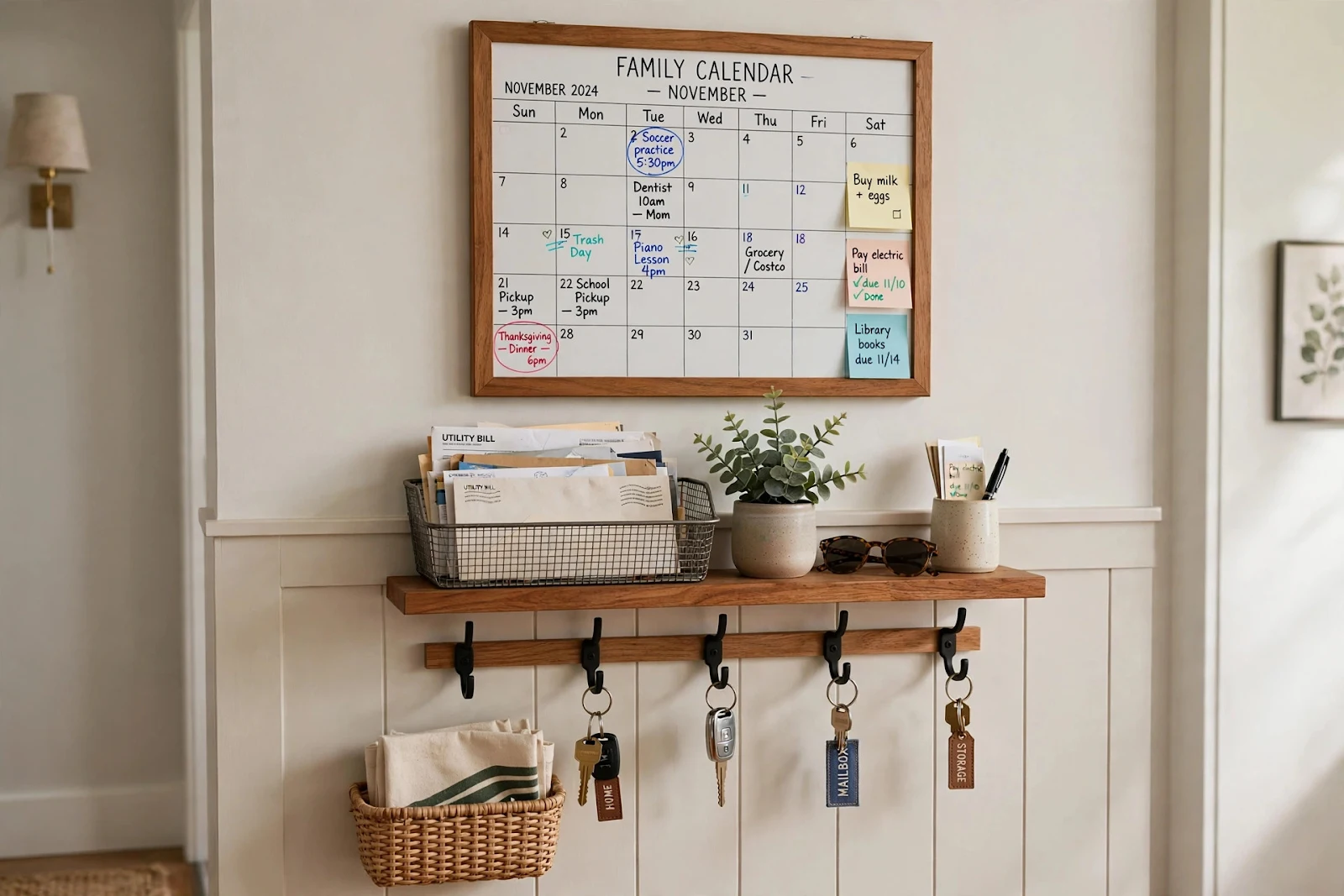
A command center works best when it is organized into four clear zones, each with one job. Mixing them together is how a station turns into a junk pile, so give each zone its own container or section.
The first zone is the calendar zone: one shared family calendar, visible to everyone. A large paper wall calendar works well because it is always visible without opening an app, and color-coding by person makes it readable at a glance. If the household already runs on a digital calendar, a small whiteboard with just the current week's key events serves the same purpose — the point is one shared view, not a perfect system. Write down school dates, work deadlines, appointments, and travel days as soon as they are known. A calendar that is only updated when someone remembers is worse than no calendar at all, because it creates false confidence.
The second zone is the keys and grab-and-go zone: a row of hooks or a small bowl for keys, plus a spot for wallets, sunglasses, and the items that leave the house every day. Labeling hooks by person prevents the daily argument over whose keys are whose, and a small tray for each adult keeps pockets' contents from spreading across the counter. The rule that makes this zone work is simple: keys live here, or they are lost. No exceptions for "just this once" on the kitchen counter.
Mail and Paperwork Without the Pile
The third zone is incoming paper: mail, school forms, permission slips, and anything that arrives on paper and needs action. This is the zone that fails most often, because paper feels harmless until the pile is a foot high. The fix is a sorter with a few labeled slots: one slot for action needed, one for each adult, and one for the kids' school papers. When mail comes in, it gets sorted immediately into a slot — not onto the counter "for later." Junk goes straight to recycling. This one habit, sorting at the door instead of stacking, is what keeps the station from becoming the new junk drawer.
The fourth zone is outgoing paper: a single tray or folder for things that need to leave the house — signed forms, return envelopes, library books, and packages waiting for a trip to the post office. When the outgoing tray is visible, nothing gets forgotten on the morning it is due. Some households add a small "this week" clipboard to this zone for lists that change constantly: grocery needs, errands, and things to buy. A clipboard beats a loose scrap of paper because it stays in one place and does not get buried.
Supplies That Keep It Running
Setting up a command center needs very little equipment, and most of it is already in the house:
- A wall calendar or whiteboard for the shared schedule
- A row of adhesive or screw-in hooks for keys and bags
- A wall-mounted mail sorter, a set of magazine holders, or labeled baskets
- A pen cup or a magnetic pen holder attached to the calendar
- A small tray or bowl for wallets, sunglasses, and pocket items
- A label maker or a marker and tape for labeling slots and hooks
Mounting is the only part that needs a little care. Use proper wall anchors for anything that will hold weight, like a shelf or a row of hooks carrying bags. Adhesive hooks work well on smooth painted walls for keys, but they fail on textured surfaces and under heavy bags. A small level and a pencil for marking positions before drilling takes five minutes and prevents the crooked row of hooks that makes the whole station look slapdash.
Getting the Whole Household to Actually Use It
A command center only works if everyone uses it, and that takes a short family conversation rather than a big announcement. Agree on the rules together: keys go on the hooks, mail gets sorted at the door, the calendar gets updated when a date is set. Kids old enough for school can have their own hook and their own school-paper slot, which gives them ownership instead of making the station feel like a parent-only zone. The first week takes reminders; after that, the habit usually holds because the station makes mornings visibly easier.
The weekly reset is what keeps the system alive long-term. Pick one quiet moment each week — Sunday evening works well for most households — and spend ten minutes on it: clear the action slots, move completed papers to filing or recycling, update the calendar for the coming week, and toss anything that has been sitting untouched for a month. Without a reset, even the best station slowly fills up and stops working. With one, it stays useful for years. If a zone keeps overflowing, that is useful information: it means the household needs a bigger slot for that category, not that the system failed.

Command Centers for Small Spaces
Small homes and apartments can absolutely have a command center — the station just gets more compact. A single floating shelf with hooks underneath covers keys and a mail tray in about two feet of wall. The inside of a coat closet door can hold a small calendar, hooks, and a hanging sorter without taking any wall space at all. A rolling cart tucked beside the door works when wall mounting is not allowed, as in a rental: calendar on top, mail in the middle basket, keys in a small dish on the side.
In a rental, removable solutions are the answer: adhesive hooks rated for the right weight, a leaning shelf that needs no screws, and a freestanding mail sorter on a console table. The station does not need to be built into the home to work — it needs to be in the path, visible, and consistent. Renters who move the station to the same relative spot in each new home — always by the main door — find the habit transfers with them.
Mistakes That Turn a Station Into Clutter
Three mistakes quietly kill most command centers. The first is making it a drop zone for everything: bags, coats, sports gear, and random objects that have no slot. A command center handles keys, mail, calendars, and daily carry items — not the whole contents of the hallway. Coats and bags need their own hooks or closet nearby, or they will bury the station.
The second mistake is having no exit for paper. Every piece of paper in the station should have a destination: action, filing, or recycling. Paper that has been "handled" but left in the slot is clutter with extra steps. When a bill is paid or a form is signed, it leaves the station that day — filed, sent, or recycled.
The third mistake is building a system that only one person understands. If the labels are cryptic or the calendar uses a private shorthand, nobody else will use it. Keep labels plain ("Action," "School," "To Send"), keep the calendar readable from three feet away, and keep the rules to the handful everyone agreed on. A system the whole household can read is a system the whole household will use.
A family command center is one of the smallest organizing projects with the biggest daily payoff. Pick the spot on the path everyone already walks, set up four simple zones for the calendar, keys, incoming paper, and outgoing items, and protect it with a ten-minute weekly reset. Within a couple of weeks, the familiar morning scramble — the missing keys, the forgotten form, the calendar nobody checked — starts to fade. The house does not need to be bigger or tidier in general. It just needs one small station where the important things always live.
