Why Coffee Table Styling Matters More Than You Think
The coffee table is the anchor of the living room. It sits at eye level when you are seated, it is the surface your guests actually look at during a conversation, and it is the spot where clutter accumulates faster than anywhere else in the house. A well-styled coffee table makes the whole room feel finished. A neglected one makes even an expensive sofa look like it is waiting for the rest of the furniture to arrive.
The good news is that styling a coffee table is one of the cheapest decorating moves you can make. You do not need new furniture or a designer. You need a few objects, a sense of proportion, and an understanding of how the eye reads a surface. Most of the work is subtraction — removing what does not belong — rather than addition.
The goal is a look that feels collected, not cluttered. Collected means the objects look intentional, like they were chosen over time and placed with care. Cluttered means everything is fighting for attention at the same height, with no breathing room. The difference comes down to three things: varying heights, grouping by threes, and leaving empty space.
The Formula: Height, Odd Numbers, and Breathing Room
Interior stylists return to the same simple framework again and again, and it works because it matches how human vision organizes information.
Vary the heights
Objects arranged in a flat line all look the same, and the eye slides right past them. Objects at different heights create a little skyline, and the eye moves up and down, which reads as interesting. A stack of two or three books (about four inches tall), a small vase with stems (about ten to twelve inches), and a low candle or bowl (two to three inches) give you three distinct levels. That is all you need.
Group in odd numbers
Three objects grouped together almost always look better than two or four. The asymmetry forces a hierarchy — a tallest piece, a middle piece, a smallest — and the result looks natural rather than staged. This applies whether you are styling one end of the table or the whole surface. A group of three reads as one composition; a group of four reads as two pairs competing with each other.
Leave some surface empty
A coffee table still has a job to do. It holds drinks, feet, remotes, and the occasional laptop. If every square inch is decorated, the styling becomes an obstacle instead of an accent. Aim to cover roughly half to two-thirds of the surface with objects and leave the rest clear. Negative space is not wasted space — it is what lets each object be seen.
Step One: Clear Everything and Start Fresh

Take everything off the table. Every book, every candle, every remote, every half-finished puzzle. Wipe the surface clean. This reset matters more than it sounds, because it lets you see the table's actual size and shape before you start placing things. Most coffee tables are between thirty-six and forty-eight inches long and eighteen to twenty-four inches deep. That is not much room, which is why editing is the first skill to practice.
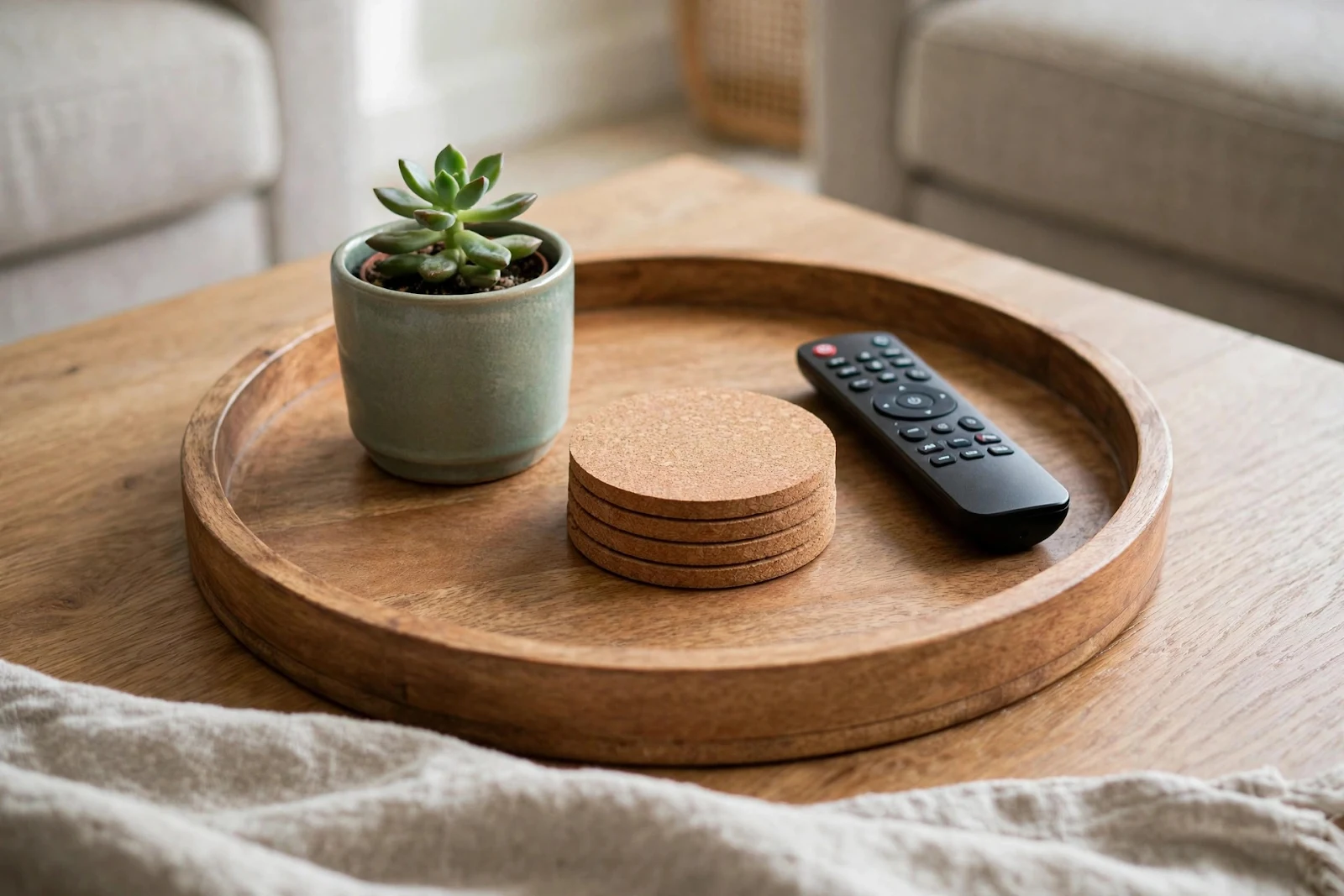
Sort what you removed into three piles: things that live on the table permanently (your favorite books, the good candle), things that are useful but ugly (the remote, coasters you need), and things that do not belong at all (mail, charging cables, the sunglasses you keep losing). Only the first pile comes back. The useful-but-ugly pile gets a container — a lidded box or a tray — so it stays hidden but accessible. The third pile goes to its real home.
Step Two: Build the Foundation With a Tray or Books
Every well-styled coffee table has an anchor — something that defines a zone on the surface and gives smaller objects a place to live. Two options work for almost every table.
A tray is the fastest anchor. A rectangular or round tray, roughly twelve to eighteen inches across, corrals small items into one visual unit. Without a tray, five small objects scattered on the table look like clutter. On a tray, the same five objects look like a curated collection. Trays come in wood, metal, lacquer, and woven materials — pick one that contrasts slightly with your table surface so it reads as a distinct layer.
A stack of books is the other classic anchor. Two or three large-format books — art, photography, architecture, or travel titles — stacked with the largest on the bottom, create a solid platform. Coffee-table books are ideal because they are wide and flat, and their covers contribute color and texture. Align the stack either centered on the table or offset to one end, depending on where your other groups will sit. Place the stack so the spines face outward or alternate directions for a more casual feel.
On a round table, a round tray mirrors the shape nicely. On a long rectangular table, consider two anchors — a book stack on one third and a tray on another — with the middle section left open. This creates the grouped-by-threes structure at the level of the whole table.
Step Three: Add Height With Something Living
Height is the element most coffee tables are missing. A low arrangement of flat objects looks unfinished because nothing draws the eye upward. The fix is something with vertical presence, and the best candidates are living things.
A small potted plant works on nearly any table. Choose one with a compact footprint — a succulent, a small fern, or a trailing pothos in a ceramic pot. The pot itself matters: ceramic, stoneware, or textured clay pots look intentional; flimsy plastic nursery pots do not. If the plant is healthy and the pot is nice, this single object can carry the whole composition.
Fresh or dried stems in a vase are the classic alternative. Dried flowers, pampas grass, eucalyptus, or bunny tails last for months with zero care and add height without maintenance. Fresh flowers are beautiful but short-lived, so dried stems are the more practical default. Keep the vase modest in size — a coffee-table vase should be five to eight inches tall at most, or the arrangement starts competing with the sightlines of people sitting across from each other.
Branches in a tall vessel work too, especially in minimalist rooms where a simple sculptural branch reads as art. Whatever you choose, the tallest element should sit slightly off-center rather than dead in the middle of the table. Off-center placement looks relaxed; dead-center looks like a hotel lobby.
Step Four: Layer In Texture and Scent
With height handled, add the small objects that give the table character. This is where personal taste shows, and where restraint matters most. Pick two or three, not ten.
- A scented candle. Candles add warmth and fragrance, and the flicker of a real flame makes a room feel alive in the evening. Choose a candle in a glass or ceramic vessel that looks good unlit, since most of its life is spent unlit. A wooden lid or a stone base elevates an ordinary candle into a design object.
- A small bowl or dish. A low ceramic bowl, a brass dish, or a carved wood catchall gives small loose items a home — keys, a watch, wrapped mints. It also adds a material contrast: something round and smooth against the rectangular lines of the books.
- A sculptural object. One piece with an interesting shape — a carved stone, a ceramic knot, a small abstract figure — adds the personal, collected feel that separates a styled table from a showroom display. This is the object that should be the most "you."
- Coasters that look good. Coasters are non-negotiable for protecting the table, and the pretty ones — stone, leather, or patterned ceramic — can stay out as part of the composition instead of hiding in a drawer.
Arrange these small pieces in a loose triangle within their zone rather than a straight row. Slight asymmetry looks natural; perfect alignment looks stiff.
Step Five: Hide the Ugly Essentials
A real coffee table has to hold a remote control, and possibly chargers, reading glasses, and a tissue box. The trick is not pretending these things do not exist — it is giving them a disguised home.
A lidded decorative box is the simplest solution. It holds the remote, the glasses, and whatever else needs to be within reach, and the lid keeps it all invisible. Boxes with interesting lids — marble, lacquered wood, woven seagrass — double as design objects.
A stack of books can hide a lot too. The remote slides behind a book stack or under the edge of a tray and stays reachable but out of the sightline. Coasters in a holder or a neat stack look intentional. A charging cable can run under the table to an outlet, with only the phone end resting on a small dish.
The rule is simple: if it is functional, it can stay — as long as it has a designated place and it is not the first thing your eye lands on.
Common Mistakes That Make a Table Look Cluttered
Once you know the mistakes, they are easy to avoid.
Everything at the same height. A row of low objects — three candles, all the same size — reads as a line, not a composition. Vary the levels.
Too many small objects. A table covered in tiny trinkets looks busy no matter how nice each piece is. Fewer, larger objects always look more expensive than many small ones.
Nothing green or alive. Rooms without anything living feel flat. One plant or one vase of stems fixes it.
Matching sets. A perfectly matched candle-holder-and-bowl set looks like it came from a gift box, not a life. Mix materials and eras — old with new, rough with smooth.
Seasonal items past their season. The pumpkin stays through Thanksgiving, not through February. Swap one or two pieces with the seasons to keep the table feeling current: lighter ceramics in spring, warmer textures in fall.
A Five-Minute Refresh When Guests Are Coming
The real test of a coffee table is the unexpected guest. Keep a simple routine: sweep the clutter into a basket (sort it later), straighten the book stack, fluff the plant's leaves, light the candle if it is evening, and check that the coasters are accessible. Five minutes turns a lived-in table into a styled one, because the underlying structure — the anchors, the heights, the empty space — is already there. That is the point of doing the work once: the maintenance is almost nothing.
A styled coffee table will not change your life. But it changes the feeling of the room you spend the most time in, and it costs nothing but an hour of your attention. Few decorating projects offer a better return on that investment.
