A floor lamp looks like a simple purchase until it arrives in the room. Too tall, and the shade glares straight into the eyes of anyone sitting nearby. Too short, and the light pools on the floor while the reading chair stays dim. The difference between a lamp that disappears into the background and one that makes a room feel finished comes down to three things: height, light, and placement.
Getting those three right requires measuring instead of guessing. A lamp that works beside a sofa will not necessarily work beside a bed, and a lamp that flatters a living room can look lost in a dining room. A few clear rules cover almost every situation, and once those rules are understood, choosing becomes a matter of matching numbers to the room.
Why Height Matters More Than Style
Style gets most of the attention in a shop, yet height decides whether a lamp actually works. The general rule is simple: the bottom edge of the lampshade should sit at roughly eye level for a seated person. For most adults on a standard sofa or armchair, that puts the bottom of the shade between 42 and 48 inches from the floor, and the total lamp height between 58 and 64 inches.
When the shade sits too high, the bulb becomes visible from a seated position, and the glare is immediate and tiring. When the shade sits too low, the light never reaches the page or the conversation area it was meant to serve. A lamp with an adjustable or swing arm solves this neatly, because the shade can be raised, lowered, or angled after the lamp is in place. Ceiling height changes the calculation too: in a room with an 8-foot ceiling, a lamp taller than 66 inches starts to crowd the space, while in a room with a 10-foot ceiling, a taller arc or torchiere design fills the vertical space better.
The Main Types of Floor Lamp
Standard floor lamps are the most common design: a straight pole, a shade, and a bulb that points downward or outward. A drum shade spreads light sideways and upward, which softens a room, while a narrower tapered shade directs more light downward, which suits reading.
Torchiere lamps point the bulb upward, bouncing light off the ceiling. That indirect light fills a room evenly and removes harsh shadows, which makes torchieres a strong choice for dark corners and rooms with little natural light. The trade-off is that a torchiere gives almost no useful reading light on its own, so pairing one with a smaller reading lamp often works better than expecting one lamp to do both jobs.
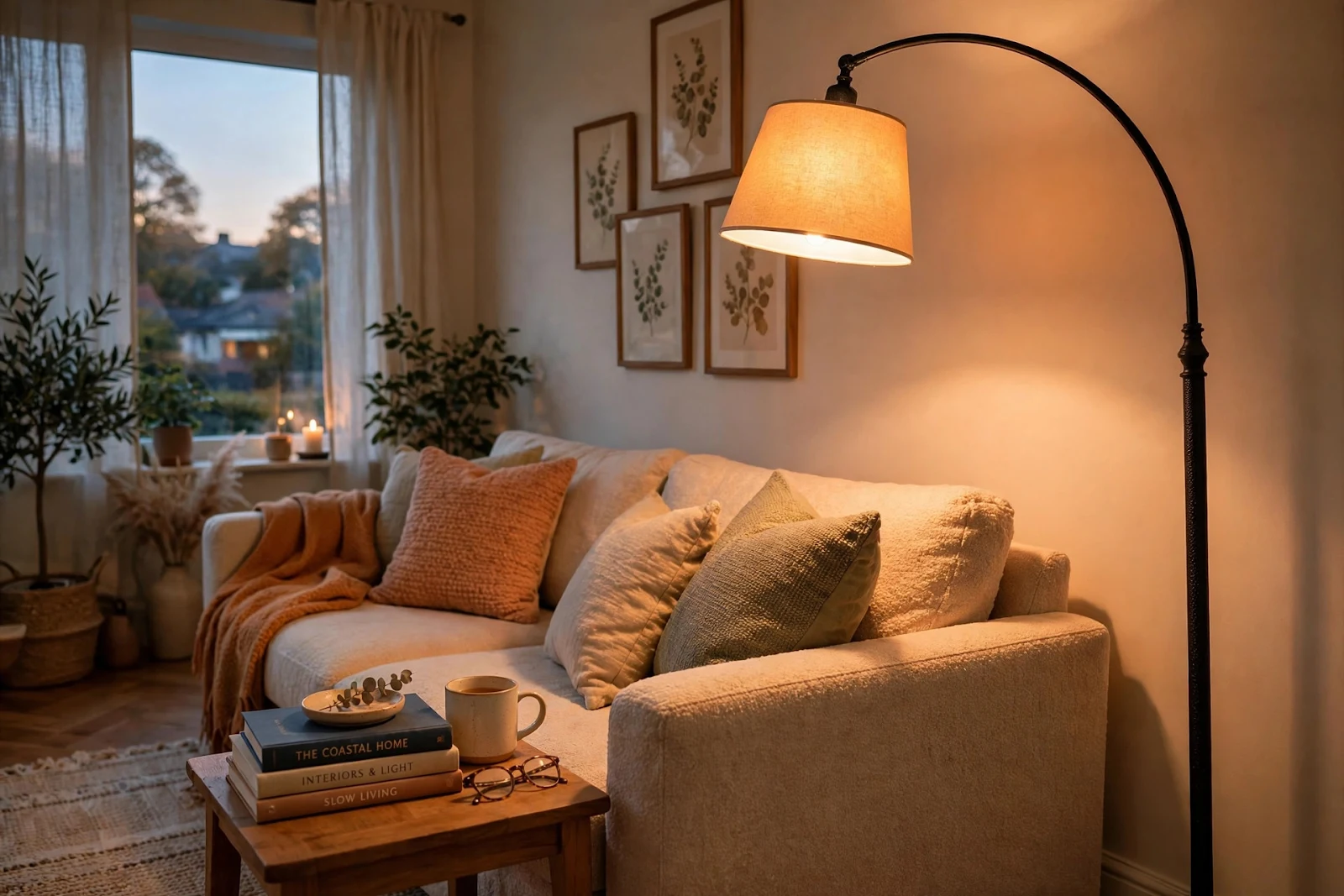
Arc lamps sweep outward from a heavy base, so the shade hangs over a sofa or table instead of standing beside it. The shade typically hangs 60 to 72 inches from the floor, which puts the light above head height for a seated person and keeps glare out of the line of sight. Reading lamps and pharmacy lamps have a narrow shade and an adjustable arm that aims light directly at a page, with the shade about 12 to 18 inches above the reading surface. Tripod lamps, with three legs instead of a single pole, suit wide, empty corners as a design statement, but the legs spread the footprint, so a tripod lamp is a poor choice for a tight walkway.
Light Temperature and Brightness, in Plain Numbers
Brightness is measured in lumens, not watts, and the number on the box is the one that matters. For ambient light in a living room, a floor lamp should deliver around 800 to 1,100 lumens, roughly the output of a traditional 60 to 75 watt bulb. For a dedicated reading lamp, 450 to 800 lumens aimed at the page is enough, because the light is concentrated instead of spread across the room.
Colour temperature is measured in kelvin, and it changes the mood of a room more than most people expect. Warm white light, around 2700K, feels cosy and relaxed, and it suits living rooms and bedrooms. Neutral white, around 3000K to 3500K, looks cleaner and slightly more alert, which suits a home office or a reading corner. Cool daylight, 4000K and above, feels clinical in a living space and is better reserved for a workshop or a task area where colour accuracy matters.
A dimmer changes everything. A lamp with a built-in dimmer, or a dimmable LED bulb paired with a compatible dimmer switch, can shift from bright task light in the afternoon to soft background light in the evening without a second lamp. One practical detail deserves attention: check the maximum wattage printed on the lamp socket before choosing a bulb. An LED bulb rated at 9 to 12 watts usually produces 800 to 1,100 lumens, and a bulb that exceeds the socket rating is a fire risk, so the printed limit is a rule, not a suggestion.
The Living Room: Layering Light Around the Sofa
The key idea in a living room is layering: a floor lamp should add to the light from ceiling fixtures and table lamps, not compete with it. One floor lamp beside the sofa, plus a table lamp on the far side of the room, usually gives a more balanced result than two floor lamps of equal brightness facing each other.
Beside a sofa, the lamp should sit 6 to 12 inches from the arm, close enough to light a book but far enough that nobody brushes against it when standing up. The shade should clear the sofa back by a few inches, and the bulb should sit above the eye line of a seated person. If the sofa faces a television, keep the lamp out of the direct line of sight to the screen, because a bright shade in the peripheral vision causes eye strain during a long film.
In a corner, a torchiere or a tall standard lamp with a drum shade fills the empty space and lifts the whole room. A lamp placed behind an armchair, with the shade peeking over the chair back, creates a reading spot without taking up any extra floor space. For larger living rooms, two matching floor lamps can frame a sofa or a fireplace symmetrically. The lamps should be identical in height and shade size for the symmetry to work; mismatched lamps on either side of a sofa tend to look accidental rather than intentional.
The Bedroom: Soft Light at the Right Height
Bedroom lighting has a different job from living room lighting. It needs to be soft enough for winding down and bright enough for reading in bed. A floor lamp in a bedroom usually stands beside a reading chair or in a corner, because the bedside table normally holds a table lamp instead.
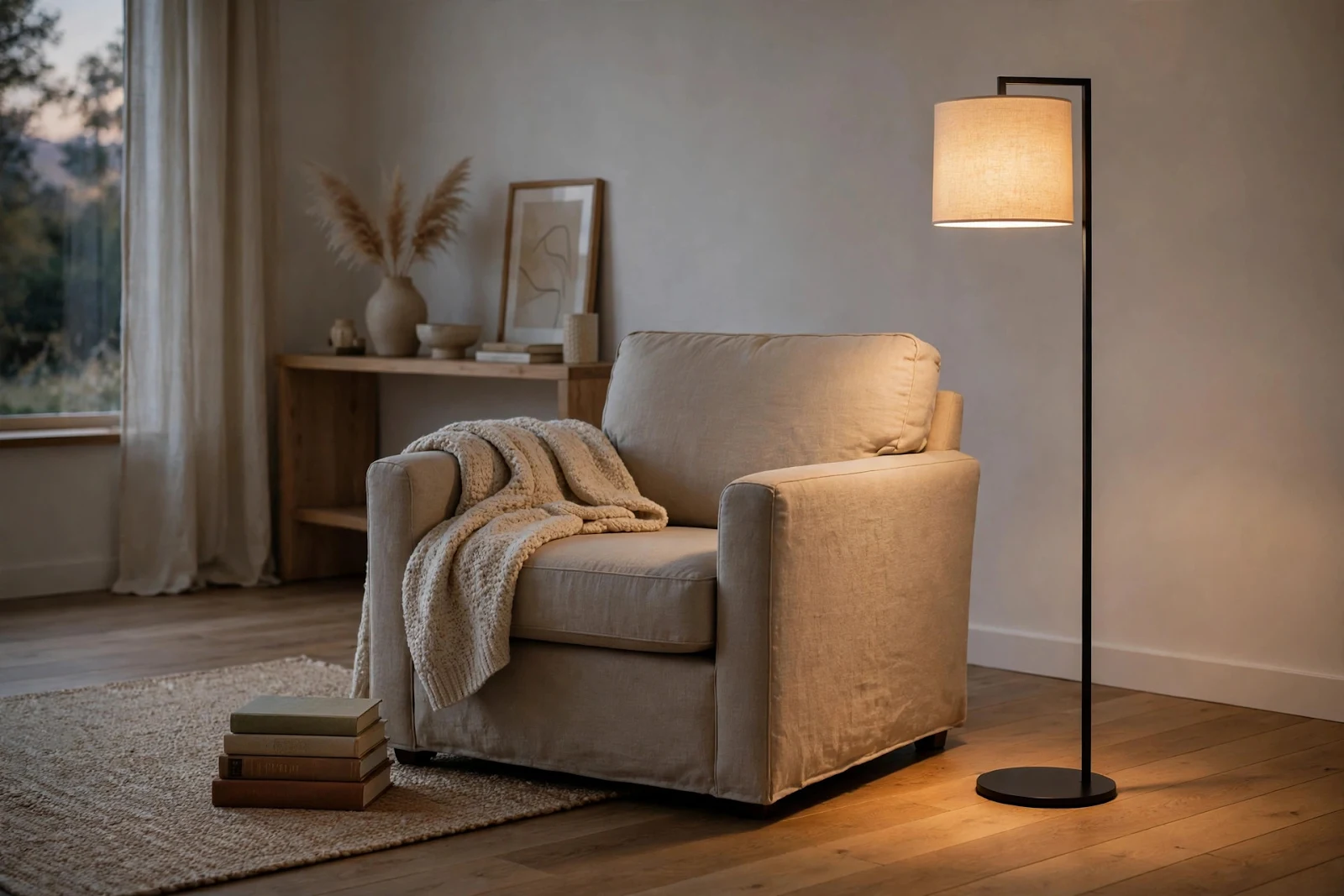
Beside a bedroom reading chair, the same height rule applies: the bottom of the shade at seated eye level, roughly 42 to 48 inches from the floor, with the light angled toward the chair. A warm bulb at 2700K suits a bedroom better than a cool one, and a dimmer is worth the small extra cost. Avoid placing a bright, bare-bulb lamp directly opposite the bed, where it shines into the eyes of someone lying down. A floor lamp can also work as the main light in a small bedroom with no ceiling fixture, but then it needs around 1,100 lumens or more, and it should stand where the light spreads evenly rather than in a corner that leaves the far side of the room dark.
Reading Nooks and the Home Office
A reading nook is the one place where a floor lamp does a single job, and the lamp should be chosen for that job alone. A swing-arm or adjustable reading lamp beats a fixed standard lamp here, because the light can be aimed precisely at the page and moved when the reader shifts position. The shade should sit about 12 to 18 inches above the book, with the bulb shielded so the reader sees the page and not the bulb.
In a home office, a floor lamp plays a supporting role to a desk lamp. It fills in the background light so the contrast between the bright desk and the dark room is less tiring on the eyes. A neutral white bulb, around 3000K to 3500K, keeps the room feeling alert without the harshness of daylight bulbs. Place the floor lamp behind or beside the desk, not directly behind the monitor, where the shade can reflect in the screen. Light from the side or from behind the chair is easier on the eyes, and a shade that directs light downward reduces screen reflections.
Placement Rules That Work in Any Room
A few placement rules apply everywhere. First, keep the lamp base out of walkways. A lamp that gets bumped every day will eventually fall, and a falling lamp with a glass shade is a hazard. If the only available spot is in a walkway, choose a lamp with a heavy, wide base, or choose a different spot. Second, keep the lamp at least 12 inches from curtains, bedding, and other fabric. A bulb generates heat, and even an LED bulb warms up over hours of use.
Third, think about the cord. A cord stretched across a walkway is a trip hazard and an eyesore, so route it along the wall, behind furniture, or under a rug with a proper cord cover. Check where the switch sits before buying, because a switch that is hard to reach will mean the lamp stays off more often than it is used. Fourth, match the scale of the lamp to the scale of the furniture. A small lamp beside a large sectional sofa looks lost, and a large arc lamp beside a small armchair overwhelms it. As a rough guide, the lamp should be roughly two-thirds the height of the tallest nearby piece of furniture, and the shade diameter should be roughly one-third the width of the sofa or chair it stands beside.
A Short Buying Checklist
Before buying, measure three things: the height of the furniture the lamp will stand beside, the distance from the floor to the seated eye level of the person who will use it, and the floor space available for the base. Write the numbers down and take them to the shop or keep them open while browsing online. A lamp that fits the numbers will work; a lamp chosen on looks alone is a gamble.
Check the socket type and the maximum wattage printed on it. Check whether the lamp has a dimmer, or whether it accepts a dimmable bulb. Check the shade size against the room, and check the base weight, because a top-heavy lamp with a light base tips easily, especially in a home with children or pets.
Finally, think about how the lamp will be used most of the time. A lamp that is mainly decorative can prioritise looks. A lamp that is mainly for reading should prioritise an adjustable arm, a shielded bulb, and the right brightness. A lamp that is the main light in a room should prioritise brightness and a dimmer. One lamp rarely does all three jobs well, and buying for the main job first is the surest way to end up with a lamp that gets used every day instead of one that gathers dust in the corner. Measure first, match the light to the job, place the lamp where the light actually lands, and the right lamp will feel less like a purchase and more like the piece the room was missing all along.
A floor lamp looks like a simple purchase until it arrives in the room. Too tall, and the shade glares straight into the eyes of anyone sitting nearby. Too short, and the light pools on the floor while the reading chair stays dim. The difference between a lamp that disappears into the background and one that makes a room feel finished comes down to three things: height, light, and placement.
Getting those three right requires measuring instead of guessing. A lamp that works beside a sofa will not necessarily work beside a bed, and a lamp that flatters a living room can look lost in a dining room. A few clear rules cover almost every situation, and once those rules are understood, choosing becomes a matter of matching numbers to the room.
Why Height Matters More Than Style
Style gets most of the attention in a shop, yet height decides whether a lamp actually works. The general rule is simple: the bottom edge of the lampshade should sit at roughly eye level for a seated person. For most adults on a standard sofa or armchair, that puts the bottom of the shade between 42 and 48 inches from the floor, and the total lamp height between 58 and 64 inches.
When the shade sits too high, the bulb becomes visible from a seated position, and the glare is immediate and tiring. When the shade sits too low, the light never reaches the page or the conversation area it was meant to serve. A lamp with an adjustable or swing arm solves this neatly, because the shade can be raised, lowered, or angled after the lamp is in place. Ceiling height changes the calculation too: in a room with an 8-foot ceiling, a lamp taller than 66 inches starts to crowd the space, while in a room with a 10-foot ceiling, a taller arc or torchiere design fills the vertical space better.
The Main Types of Floor Lamp
Standard floor lamps are the most common design: a straight pole, a shade, and a bulb that points downward or outward. A drum shade spreads light sideways and upward, which softens a room, while a narrower tapered shade directs more light downward, which suits reading.
Torchiere lamps point the bulb upward, bouncing light off the ceiling. That indirect light fills a room evenly and removes harsh shadows, which makes torchieres a strong choice for dark corners and rooms with little natural light. The trade-off is that a torchiere gives almost no useful reading light on its own, so pairing one with a smaller reading lamp often works better than expecting one lamp to do both jobs.
Arc lamps sweep outward from a heavy base, so the shade hangs over a sofa or table instead of standing beside it. The shade typically hangs 60 to 72 inches from the floor, which puts the light above head height for a seated person and keeps glare out of the line of sight. Reading lamps and pharmacy lamps have a narrow shade and an adjustable arm that aims light directly at a page, with the shade about 12 to 18 inches above the reading surface. Tripod lamps, with three legs instead of a single pole, suit wide, empty corners as a design statement, but the legs spread the footprint, so a tripod lamp is a poor choice for a tight walkway.
Light Temperature and Brightness, in Plain Numbers
Brightness is measured in lumens, not watts, and the number on the box is the one that matters. For ambient light in a living room, a floor lamp should deliver around 800 to 1,100 lumens, roughly the output of a traditional 60 to 75 watt bulb. For a dedicated reading lamp, 450 to 800 lumens aimed at the page is enough, because the light is concentrated instead of spread across the room.
Colour temperature is measured in kelvin, and it changes the mood of a room more than most people expect. Warm white light, around 2700K, feels cosy and relaxed, and it suits living rooms and bedrooms. Neutral white, around 3000K to 3500K, looks cleaner and slightly more alert, which suits a home office or a reading corner. Cool daylight, 4000K and above, feels clinical in a living space and is better reserved for a workshop or a task area where colour accuracy matters.
A dimmer changes everything. A lamp with a built-in dimmer, or a dimmable LED bulb paired with a compatible dimmer switch, can shift from bright task light in the afternoon to soft background light in the evening without a second lamp. One practical detail deserves attention: check the maximum wattage printed on the lamp socket before choosing a bulb. An LED bulb rated at 9 to 12 watts usually produces 800 to 1,100 lumens, and a bulb that exceeds the socket rating is a fire risk, so the printed limit is a rule, not a suggestion.
The Living Room: Layering Light Around the Sofa
The key idea in a living room is layering: a floor lamp should add to the light from ceiling fixtures and table lamps, not compete with it. One floor lamp beside the sofa, plus a table lamp on the far side of the room, usually gives a more balanced result than two floor lamps of equal brightness facing each other.
Beside a sofa, the lamp should sit 6 to 12 inches from the arm, close enough to light a book but far enough that nobody brushes against it when standing up. The shade should clear the sofa back by a few inches, and the bulb should sit above the eye line of a seated person. If the sofa faces a television, keep the lamp out of the direct line of sight to the screen, because a bright shade in the peripheral vision causes eye strain during a long film.
In a corner, a torchiere or a tall standard lamp with a drum shade fills the empty space and lifts the whole room. A lamp placed behind an armchair, with the shade peeking over the chair back, creates a reading spot without taking up any extra floor space. For larger living rooms, two matching floor lamps can frame a sofa or a fireplace symmetrically. The lamps should be identical in height and shade size for the symmetry to work; mismatched lamps on either side of a sofa tend to look accidental rather than intentional.
The Bedroom: Soft Light at the Right Height
Bedroom lighting has a different job from living room lighting. It needs to be soft enough for winding down and bright enough for reading in bed. A floor lamp in a bedroom usually stands beside a reading chair or in a corner, because the bedside table normally holds a table lamp instead.
Beside a bedroom reading chair, the same height rule applies: the bottom of the shade at seated eye level, roughly 42 to 48 inches from the floor, with the light angled toward the chair. A warm bulb at 2700K suits a bedroom better than a cool one, and a dimmer is worth the small extra cost. Avoid placing a bright, bare-bulb lamp directly opposite the bed, where it shines into the eyes of someone lying down. A floor lamp can also work as the main light in a small bedroom with no ceiling fixture, but then it needs around 1,100 lumens or more, and it should stand where the light spreads evenly rather than in a corner that leaves the far side of the room dark.
Reading Nooks and the Home Office
A reading nook is the one place where a floor lamp does a single job, and the lamp should be chosen for that job alone. A swing-arm or adjustable reading lamp beats a fixed standard lamp here, because the light can be aimed precisely at the page and moved when the reader shifts position. The shade should sit about 12 to 18 inches above the book, with the bulb shielded so the reader sees the page and not the bulb.
In a home office, a floor lamp plays a supporting role to a desk lamp. It fills in the background light so the contrast between the bright desk and the dark room is less tiring on the eyes. A neutral white bulb, around 3000K to 3500K, keeps the room feeling alert without the harshness of daylight bulbs. Place the floor lamp behind or beside the desk, not directly behind the monitor, where the shade can reflect in the screen. Light from the side or from behind the chair is easier on the eyes, and a shade that directs light downward reduces screen reflections.
Placement Rules That Work in Any Room
A few placement rules apply everywhere. First, keep the lamp base out of walkways. A lamp that gets bumped every day will eventually fall, and a falling lamp with a glass shade is a hazard. If the only available spot is in a walkway, choose a lamp with a heavy, wide base, or choose a different spot. Second, keep the lamp at least 12 inches from curtains, bedding, and other fabric. A bulb generates heat, and even an LED bulb warms up over hours of use.
Third, think about the cord. A cord stretched across a walkway is a trip hazard and an eyesore, so route it along the wall, behind furniture, or under a rug with a proper cord cover. Check where the switch sits before buying, because a switch that is hard to reach will mean the lamp stays off more often than it is used. Fourth, match the scale of the lamp to the scale of the furniture. A small lamp beside a large sectional sofa looks lost, and a large arc lamp beside a small armchair overwhelms it. As a rough guide, the lamp should be roughly two-thirds the height of the tallest nearby piece of furniture, and the shade diameter should be roughly one-third the width of the sofa or chair it stands beside.
A Short Buying Checklist
Before buying, measure three things: the height of the furniture the lamp will stand beside, the distance from the floor to the seated eye level of the person who will use it, and the floor space available for the base. Write the numbers down and take them to the shop or keep them open while browsing online. A lamp that fits the numbers will work; a lamp chosen on looks alone is a gamble.
Check the socket type and the maximum wattage printed on it. Check whether the lamp has a dimmer, or whether it accepts a dimmable bulb. Check the shade size against the room, and check the base weight, because a top-heavy lamp with a light base tips easily, especially in a home with children or pets.
Finally, think about how the lamp will be used most of the time. A lamp that is mainly decorative can prioritise looks. A lamp that is mainly for reading should prioritise an adjustable arm, a shielded bulb, and the right brightness. A lamp that is the main light in a room should prioritise brightness and a dimmer. One lamp rarely does all three jobs well, and buying for the main job first is the surest way to end up with a lamp that gets used every day instead of one that gathers dust in the corner. Measure first, match the light to the job, place the lamp where the light actually lands, and the right lamp will feel less like a purchase and more like the piece the room was missing all along.
